Stefan Huber

Open journal

Things worth writing down.

September 18, 2026

AI needs to be negotiated through a democratic process

Today, a friend pointed me to an interview with Rüdiger Safranski. One thing – and maybe the only thing – that stuck with me from that piece was:

History has taught us to create systems of checks and balances – in the best sense of the term. Consider the political invention of the separation of powers in the 16th century. It arose from a deep mistrust of human nature, which is inherently high-risk. It’s like a bank vault that requires two keys to prevent a single person from looting it. We must apply precisely this approach to society’s and politics’ handling of technology: we need a separation of powers there as well.

Tagesanzeiger · Jan Bolliger, Andreas Tobler · 17.09.2026


I think it resonates with my understanding that AI itself is a tool, like any other tool, but its use must be negotiated through a democratic process. It’s not new that we regulate tools – think, for example, of radio transmitters – in a way that their use can be beneficial for everyone. But it’s important that we not only shape the tools and their embedding in our system, but also the distribution of the benefits and profits that come with them.

AI
September 18, 2026

1904 Epoch

Today I learned that the old file system of Apple (HFS Plus Volume Format) – among other systems – stores dates as a number of seconds since midnight on January 1, 1904, GMT, similar to Unix time, which starts on January 1, 1970, UTC. The new Apple File System also uses Unix time and stores it with nanosecond resolution. But why 1904, I wondered? I'm not sure whether there is a definitive answer, but chances are high that the engineers wanted to avoid the year 1900 problem. Some software (namely, Lotus 1-2-3) incorrectly assumes that 1900 was a leap year. Therefore, choosing the next correct leap year (1904) as the starting point seems sensible.

TIL

September 18, 2026

Master Pages in Layout Software

In the past, I had many contacts in the print industry. For that reason, I have many old documents stored in QuarkXPress and InDesign and wanted to look for an alternative open-source software that could ideally open my existing documents. I had a look at Scribus. It had been a long time since I had last looked at it, and a lot had happened! I was surprised when I tested it by how familiar it felt – especially when you are used to other layout software. Nice!

Read more →
TILOpenSourcepublishing

July 12, 2026

Productivity paradox

When I read about the Productivity paradox on Wikipedia, I think it’s interesting to consider what computers did for productivity in the 1970s and 1980s, and why the effect on the economy wasn’t as big as one might think.

You can see the computer age everywhere but in the productivity statistics.
Robert Solow

The quote is drastic, but it might also be true today with AI: we could have an increase in productivity, but it takes a long time to reshape processes and society around a new tool before we can really benefit from it.

AITIL

July 7, 2026

How can you benefit from what others have learned?

You meet someone who participated in an activity you were not part of. How can you steer the conversation so that the other person gets something out of the discussion as well as you do? Today, I heard a great question:

What changed your perspective?

I like it a lot!

TILlearning

May 31, 2026

The Pope on AI

This week the first encyclical letter of Pope Leo XIV was published. I don't consider myself religious, but I still think some good thoughts are captured in that paper. One sentence that stuck with me was the following;

When words are simulated, they do not build genuine relationships, but only their appearance.
Pope Leo XIV · Magnifica humanitas

I think it's something to remember. Just the other day, I saw a person writing a greeting card on the train. It looked like a birthday card, and the person copied the text from a ChatGPT screen on their mobile screen. Are the words building a relationship if they become a copy of a machine? Does it even make sense to then deliver this «proof of work» that holds not much material for building emotional bridges?

AIquotes

May 17, 2026

AI on Job-Market

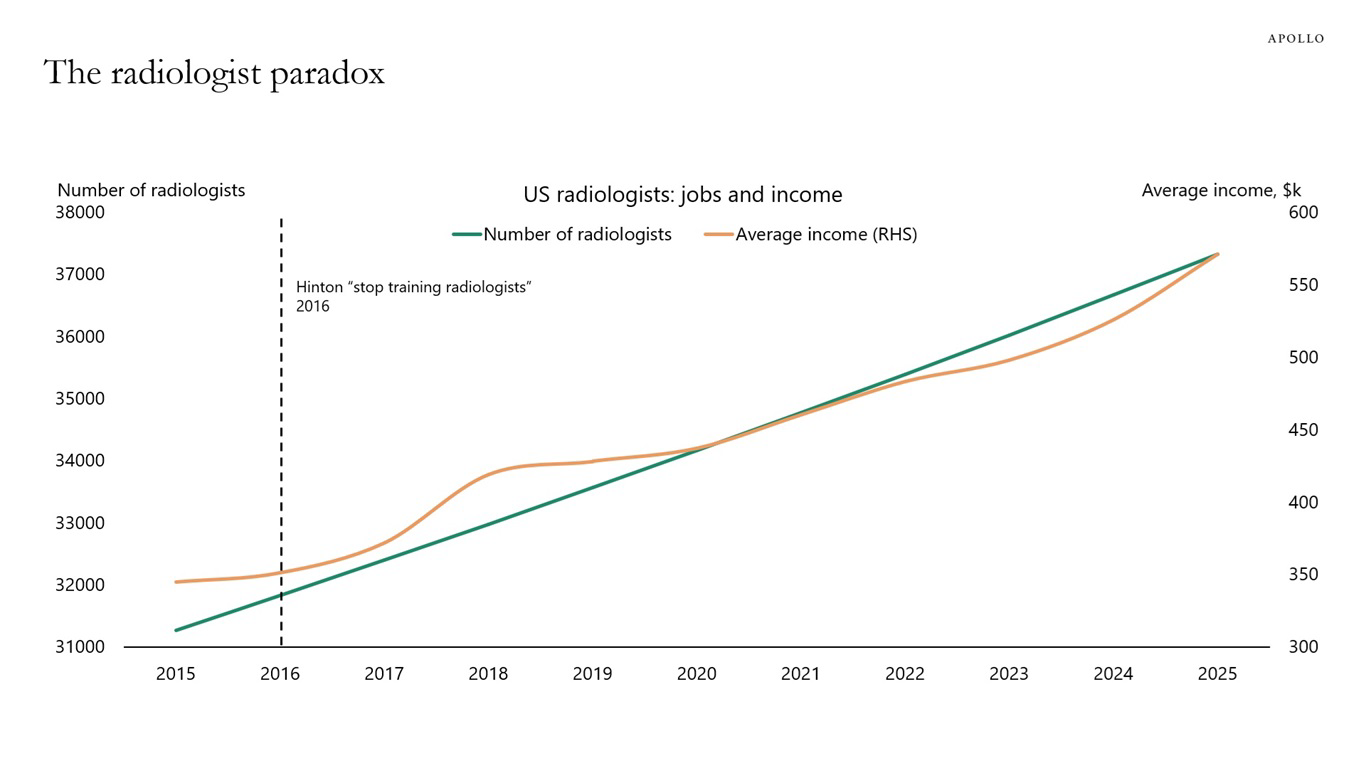
Today I saw a graphic that shows the rising income of radiologists over the last 10 years in the USA.

dailyspark_2026_04_29_9ko9p8jwfy.png

Source: Apollo · The Radiologist Paradox · Torsten Slok

Despite the fact that radiologists are highly exposed to AI, the number of radiologists and their salaries continuously rose. That made me think: the changes in the labor market driven by AI might not lower overall consumption. In the end, capitalism always adapted to the new production environment with higher consumption of the increased productivity.

AITIL

April 27, 2026

Intellectual Labor

Today I read a comment about labor in an age of LLM;

Much of the intellectual work is, in fact, intellectual labor. It’s mostly about combining various information in one place — the exact task that LLM far outperforms human.
esjeon · Hackernews

It reminded me of when I was working as a graphic designer, and people thought of my work as mainly «creative», but in reality, great output was achieved mainly through a lot of labor and applying knowledge to a problem. I often felt misunderstood that creativity comes out of nothing and is a gift or a trained muscle. It’s often just putting in hours of work to achieve an output.

AITILquotes